
Blank page. Pencil in hand. No idea what to draw.
Every artist hits this point. You want to practice but picking a subject takes more time than the actual drawing. That is where random objects help.
Drawing random objects is one of the most effective ways to improve your skills. You are not drawing what you like. You are drawing what you get. That forces you to observe, think, and sketch things outside your comfort zone.
This list gives you 50+ random objects to draw across 6 categories. Whether you are a complete beginner or someone who draws daily, these ideas will keep your sketchbook moving.
If you want to skip the list and get a random object instantly, use our Random Object Generator. It gives you drawing inspiration and random drawing ideas in one click. Start drawing in seconds.
Why Drawing Random Objects Improves Your Skills
Drawing the same things over and over builds comfort, not skill. Random objects break that habit.
Here is why it works:
You Stop Overthinking the Subject
When you pick your own subject, you spend 10 minutes deciding. A random object gives you a subject in one second. You skip the decision and go straight to drawing.
You Draw Things You Would Never Choose
A stapler. A rubber band. A worn out shoe. You would never pick these on your own. But drawing them teaches you shapes, textures, and proportions that your usual subjects never will.
Your Observation Skills Get Sharper
Random objects are mostly everyday items. Drawing them forces you to really look. How does light fall on a glass bottle? How many angles does a chair have? This kind of observation is what separates average artists from good ones.
Many professional art teachers recommend random object practice as a core daily exercise. You can explore more drawing techniques on Skillshare’s art blog.
You Build a Stronger Sketchbook
A sketchbook full of random objects shows range. It shows you can draw anything. That matters whether you are building a portfolio or just growing as an artist.
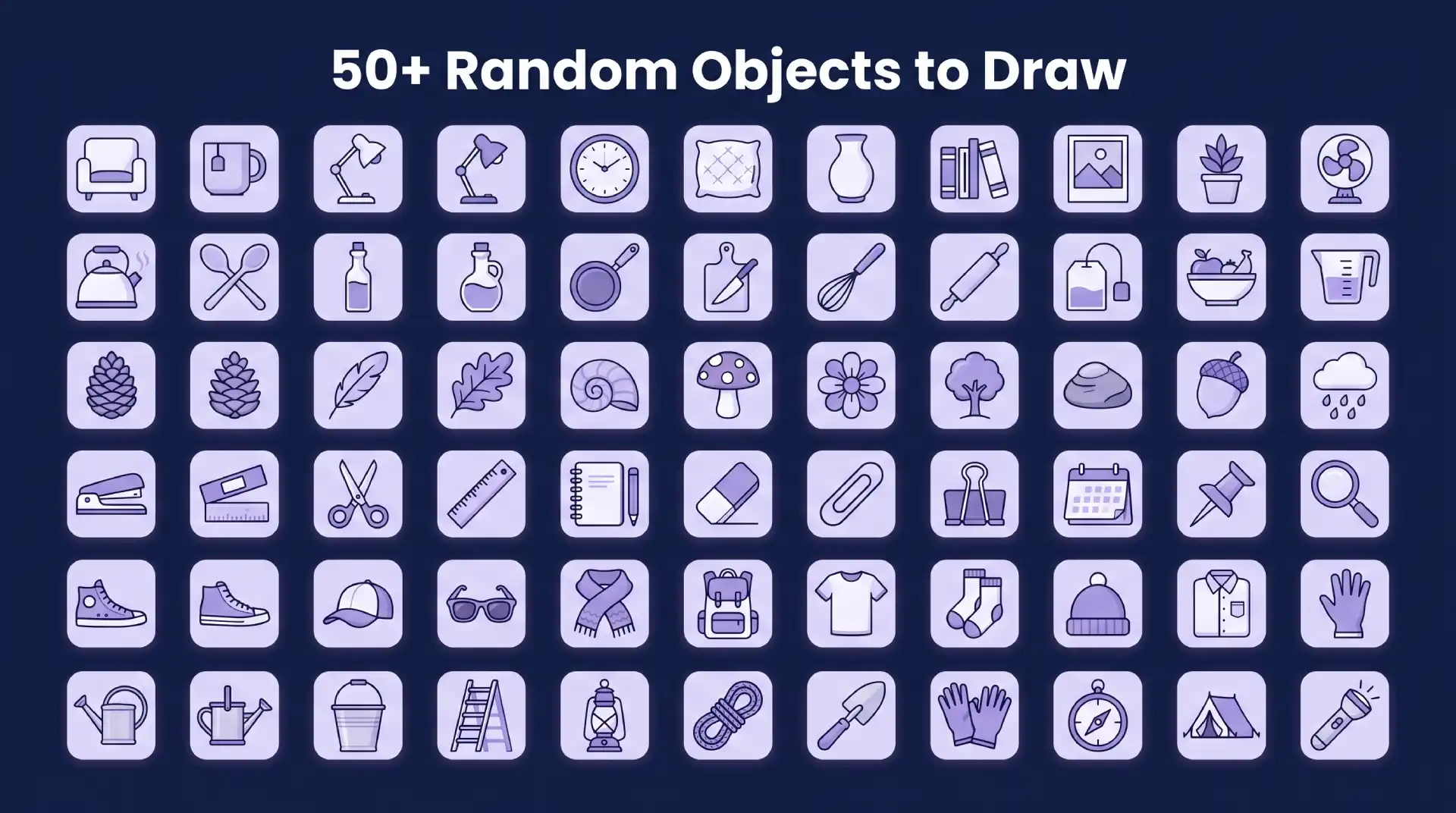
50+ Random Objects to Draw
Six categories covering everyday items, nature, kitchen, office, clothing, and outdoor objects.
Everyday Household Objects
These are the best starting points for beginners. You can find all of these at home right now.
- Chair
- Table lamp
- Mug
- Clock
- Pillow
- Mirror
- Vase
- Candle
- Book
- Wooden bowl
Kitchen Items
Kitchen objects have great shapes and textures. Perfect for still life practice.
- Kettle
- Cutting board
- Glass bottle
- Spoon
- Colander
- Mortar and pestle
- Rolling pin
- Coffee mug
- Frying pan
- Garlic bulb
Nature Objects
Nature objects teach you organic shapes and irregular textures skills no other category can match.
- Pine cone
- Smooth river stone
- Feather
- Seashell
- Dry leaf
- Acorn
- Mushroom
- Piece of bark
- Bird nest
- Flower stem
Office and School Items
Simple shapes, straight lines, and everyday detail. Great for beginners working on proportion.
- Stapler
- Scissors
- Tape dispenser
- Pencil case
- Ruler
- Stack of papers
- Notebook
- Binder clip
- Eraser
- Pen holder
Clothing and Accessories
Fabric and folds are hard to draw. These objects give you that practice.
- Old sneaker
- Baseball cap
- Leather wallet
- Wristwatch
- Sunglasses
- Scarf
- Backpack
- Belt
- Umbrella
- Gloves
Outdoor and Misc Items
These objects push you to draw bigger shapes and more complex structures.
- Bicycle wheel
- Garden pot
- Watering can
- Padlock
- Rope
- Toolbox
- Old boot
- Ladder
- Bucket
- Lantern
How to Use Random Objects for Drawing Practice
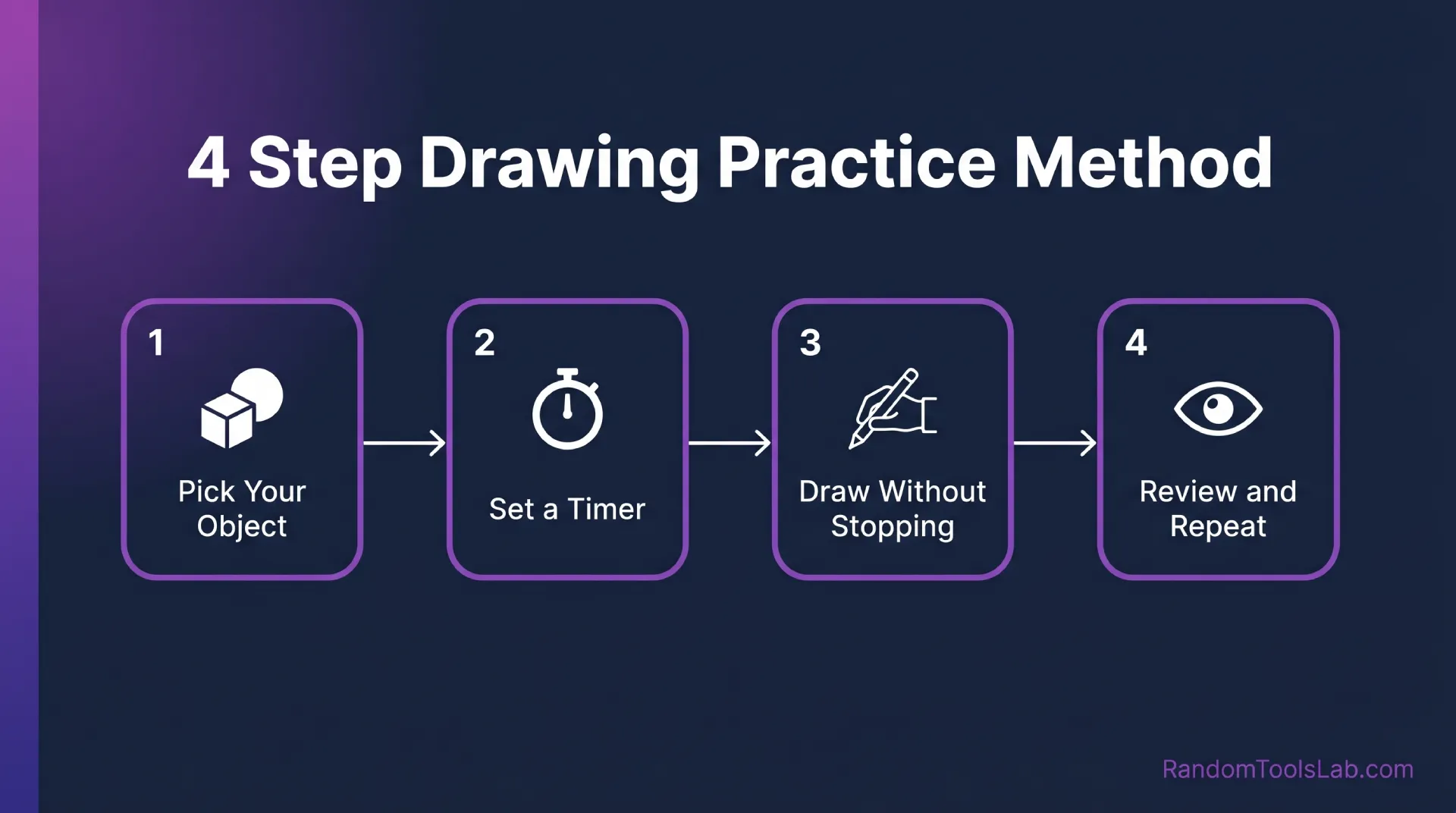
A simple 4 step method that works for beginners and experienced artists both.
Pick any object from the list above or use our Random Object Generator to get one instantly. Then follow these steps.
Step 1: Pick your object Choose one object only. Not two, not three. One object keeps your focus sharp and your session productive.
Step 2: Set a timer Give yourself 10 to 15 minutes. A timer stops you from overthinking and keeps the session moving. Beginners can start with 20 minutes if 10 feels too short.
Step 3: Draw without stopping Do not erase. Do not restart. Just draw what you see. The goal is observation and practice, not a perfect result.
Step 4: Review and repeat When the timer ends, look at your drawing for 1 minute. What worked? What did not? Then pick a new object and go again.
That is the full method. Simple, fast and effective. Do this 3 to 4 times per week and you will see real improvement within a month. It is one of the best ways to turn drawing ideas into a real daily habit.
Tips for Beginners
Small changes in how you practice make a big difference in how fast you improve.
Start with Simple Shapes
Before you draw the full object, break it into basic shapes. A mug is a cylinder. A book is a rectangle. Starting with shapes makes any object easier to draw.
Do Not Aim for Perfection
Your first 100 drawings will not be great. That is normal. The goal of random object practice is to draw more, not to draw perfectly. Perfection comes later.
Use the Object in Front of You
Do not draw from memory. Put the actual object on your desk and draw what you see. Real observation builds real skill.
Rotate Your Categories
Do not draw household objects every day. One day pick a nature object. Next day pick a clothing item. Rotating categories keeps your practice balanced and builds a wider skill set.
Keep a Sketchbook Only for This
Have one sketchbook only for random object practice. After 30 days, look back at page one. The improvement will surprise you.
Try a 30 Day Random Object Drawing Challenge
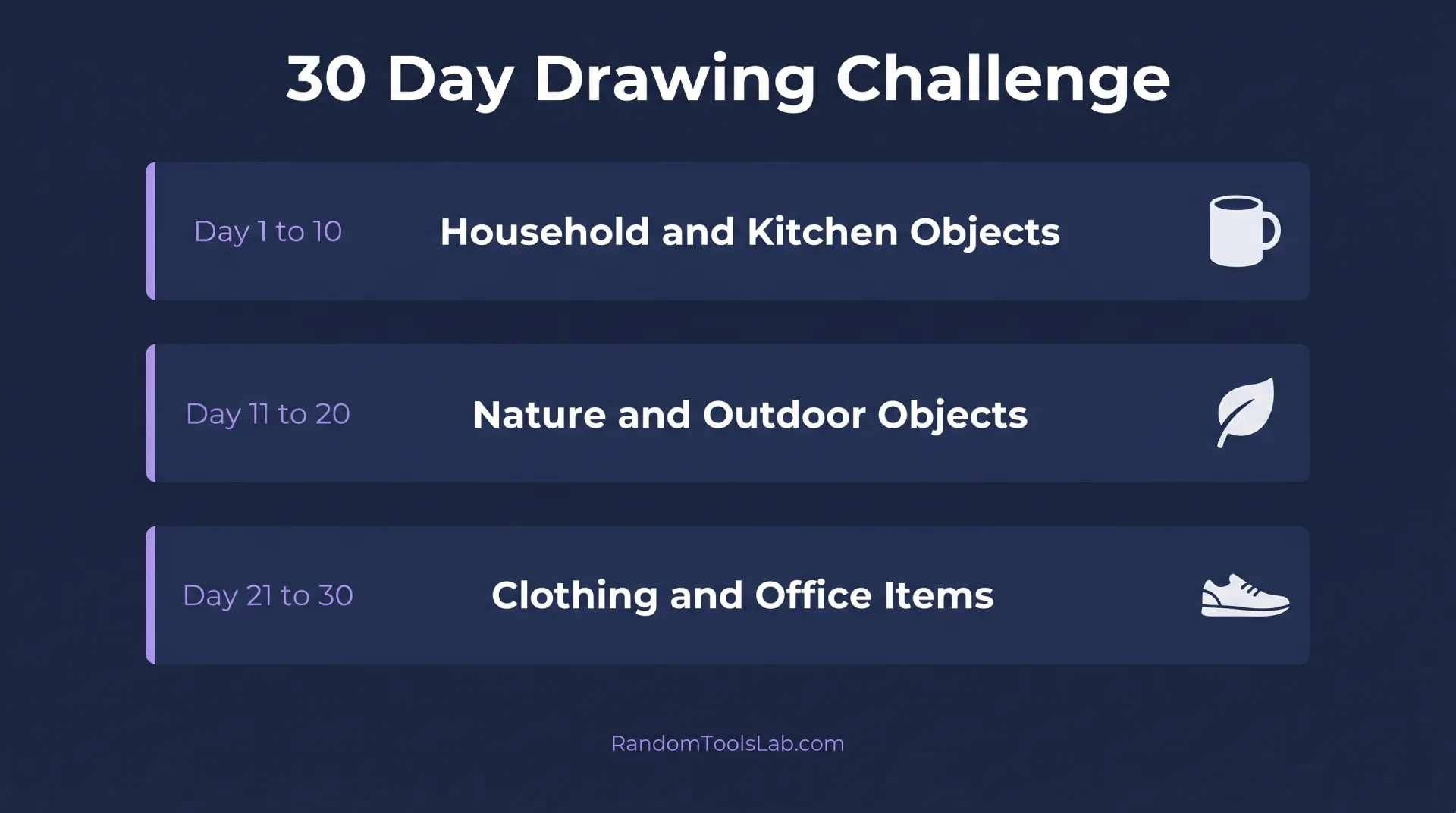
The idea is simple. Draw one random object every day for 30 days. No pressure, no perfect results. Just consistent practice.
Here is how to run the challenge:
Day 1 to 10: Household and Kitchen Objects
Start with objects around your home. These are easy to find and great for building basic observation skills. Pick one object each day and draw it within 15 minutes.
Day 11 to 20: Nature and Outdoor Objects
Move to more irregular shapes. Leaves, pine cones, stones and outdoor items. These teach you how to draw organic forms that household objects cannot.
Day 21 to 30: Clothing, Accessories and Office Items
Finish with the harder categories. Fabric folds, leather textures and detailed objects. By day 21 your observation skills will be strong enough to handle these.
Track Your Progress
After day 30, open your sketchbook to day 1. Compare the first drawing with the last. The difference will show you exactly how much you improved.
Use our free Random Object Generator for instant drawing inspiration and fresh sketchbook ideas.
Frequently Asked Questions
Most common questions people ask about drawing random objects.
What are good random objects to draw for beginners?
Start with simple household items. A mug, a book, a lamp or a candle are all great. Clear shapes, easy to find at home, not too much detail.
How do I pick a random object to draw?
Use our Random Object Generator and get one in a single click. No list needed, no time wasted deciding.
Does drawing random objects actually improve your skills?
Yes. It forces you to draw things outside your comfort zone. That builds observation skills and proportion skills faster than drawing the same subjects every day.
How many objects should I draw per day?
One object per day is enough. Spend 15 to 20 minutes on it properly. Quality matters more than quantity.
What household objects are easiest to draw for beginners?
A mug, a book, a candle and a bowl. Simple shapes, clear outlines and minimal detail. Perfect starting points.
Can I use a random object generator for daily drawing practice?
Yes. It removes the time you waste deciding what to draw. Our free random object generator gives you one object instantly or up to 100 at once with category filters.
What is the best way to practice drawing objects every day?
Pick one object, set a 15 minute timer and draw without stopping. Review for one minute when done. Do this 3 to 4 times per week.
Summary
- Drawing random objects is one of the fastest ways to improve your observation and sketching skills
- A list of 50+ objects across 6 categories gives you enough variety for months of practice
- Start with household items, move to nature objects, then work up to clothing and outdoor items
- The 4 step method works for any skill level. Pick an object, set a timer, draw without stopping, review and repeat
- One object per day for 30 days is enough to see real improvement in your sketchbook
- Do not overthink the subject. Random drawing ideas and art prompts remove that problem completely. The faster you start, the faster you improve
Use our free Random Object Generator to get your next drawing subject in one click. No list, no decisions, just draw.