
You have a pencil in your hand and a blank page in front of you. No idea what to draw. That feeling is more common than you think.
The good news is you do not need inspiration to start. You just need a subject. This list gives you 100+ things to draw when bored across 6 categories. Every idea works for beginners and experienced artists both. And if the list feels too long, our free drawing idea tool gives you one instant idea in a single click
Why Drawing When Bored Actually Works
Drawing as an art form is one of the oldest forms of human expression, practiced across all cultures for thousands of years. That is why picking up a pencil when boredom strikes feels so natural.
Boredom removes pressure. When you are not trying to impress anyone or finish a project, you draw more freely. That freedom is where real practice happens.
Random subjects make you better faster. Choosing your own subjects every day means you always pick what feels comfortable. Boredom forces you to draw things you would never choose on your own. A stapler, a worn out shoe, an old clock. These objects teach you shapes, textures, and proportions that your usual subjects never will.
You also stop overthinking. When boredom hits and you just pick something and draw it, you skip the 10 minutes of deciding and go straight to the pencil. That is where improvement actually starts.
100+ Things to Draw When Bored
Six categories covering everything from simple objects to creative ideas.
1. Easy Everyday Objects
Best for complete beginners. Skill focus is basic shapes and outlines.
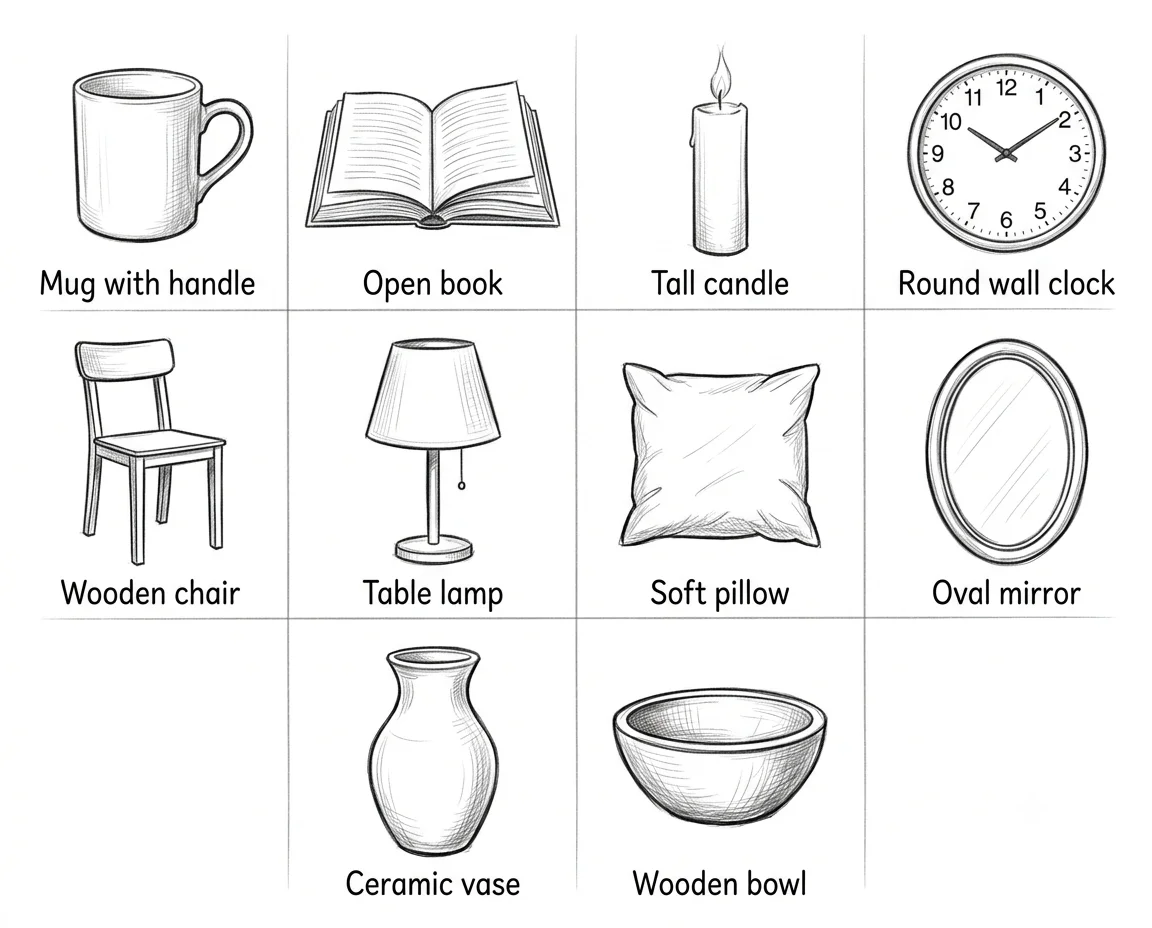
Mug
A simple cylinder with a handle. Great for practicing curves.
Book
Flat rectangle with pages. Good for straight lines and perspective.
Candle
Tall cylinder with a flame on top. Easy and satisfying to draw.
Clock
A circle with numbers. Great for practicing symmetry.
Chair
Four legs and a seat. Good for learning basic proportions.
Lamp
A base with a shade on top. Simple shapes combined together.
Pillow
Soft rectangle with gentle curves. Good for shading practice.
Mirror
Oval or rectangle with a frame. Easy and quick to sketch.
Vase
Curved body with an open top. Great for practicing smooth lines.
Wooden Bowl
Simple round shape with depth. Good for shading and form.
2. Nature and Outdoor Objects
Best for learning organic shapes. Skill focus is irregular lines and textures.
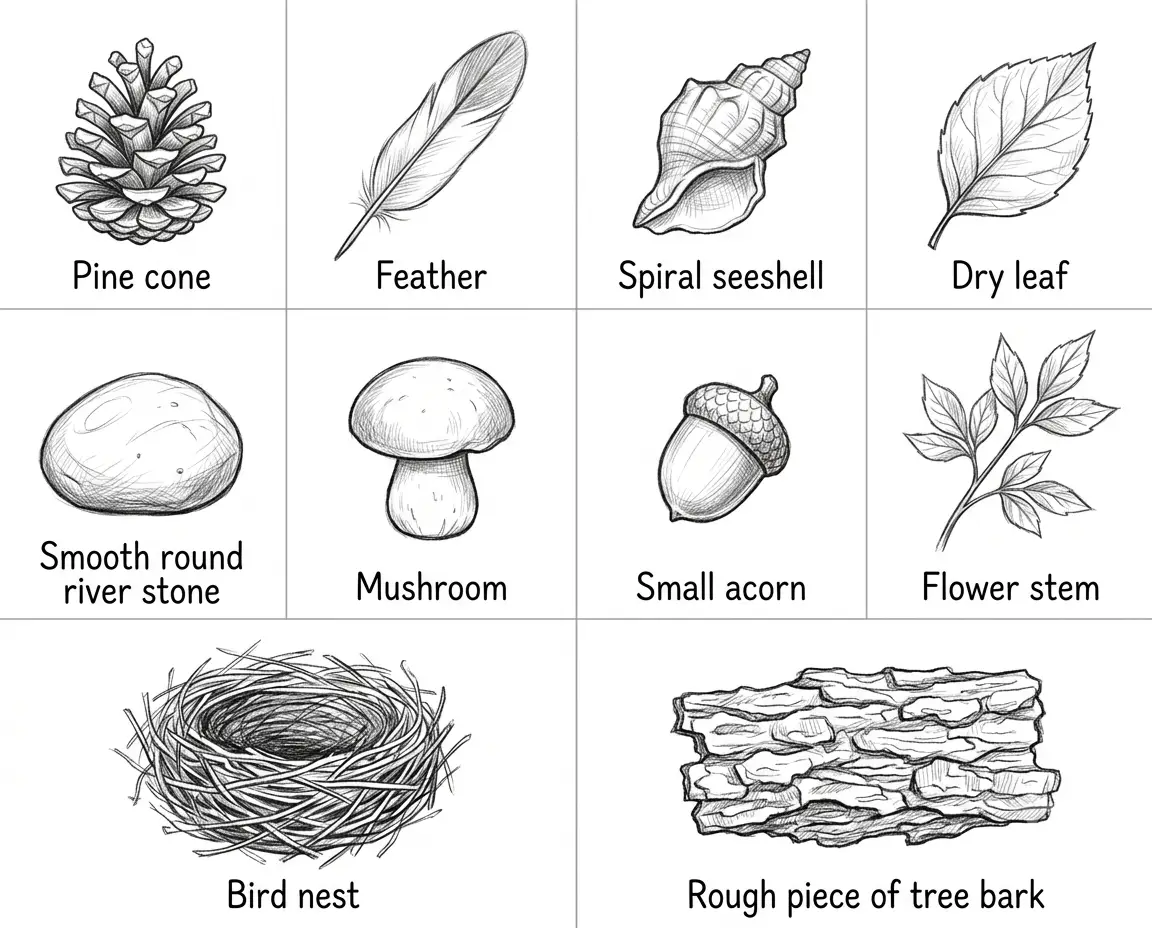
Pine Cone
A layered oval shape with overlapping scales. Great for practicing repeating patterns.
Feather
A thin stem with soft edges on both sides. Good for light and flowing lines.
Seashell
A spiral shape with ridges and curves. Great for practicing texture and detail.
Dry Leaf
An irregular shape with visible veins. Good for observing and drawing natural lines.
Smooth River Stone
A simple oval with no sharp edges. Perfect for shading and soft form practice.
Mushroom
A round cap on a short stem. Easy shape with good shading opportunities.
Acorn
A small oval with a textured cap on top. Good for combining two different textures.
Flower Stem
A long thin line with leaves attached. Great for practicing light and confident strokes.
Bird Nest
A round bowl shape made of tangled lines. Good for loose and free hand drawing.
Piece of Bark
A rough rectangle with uneven edges and lines. Great for texture and detail practice.
3. Food and Kitchen Items
Best for practicing still life. Skill focus is shape clarity and shading.
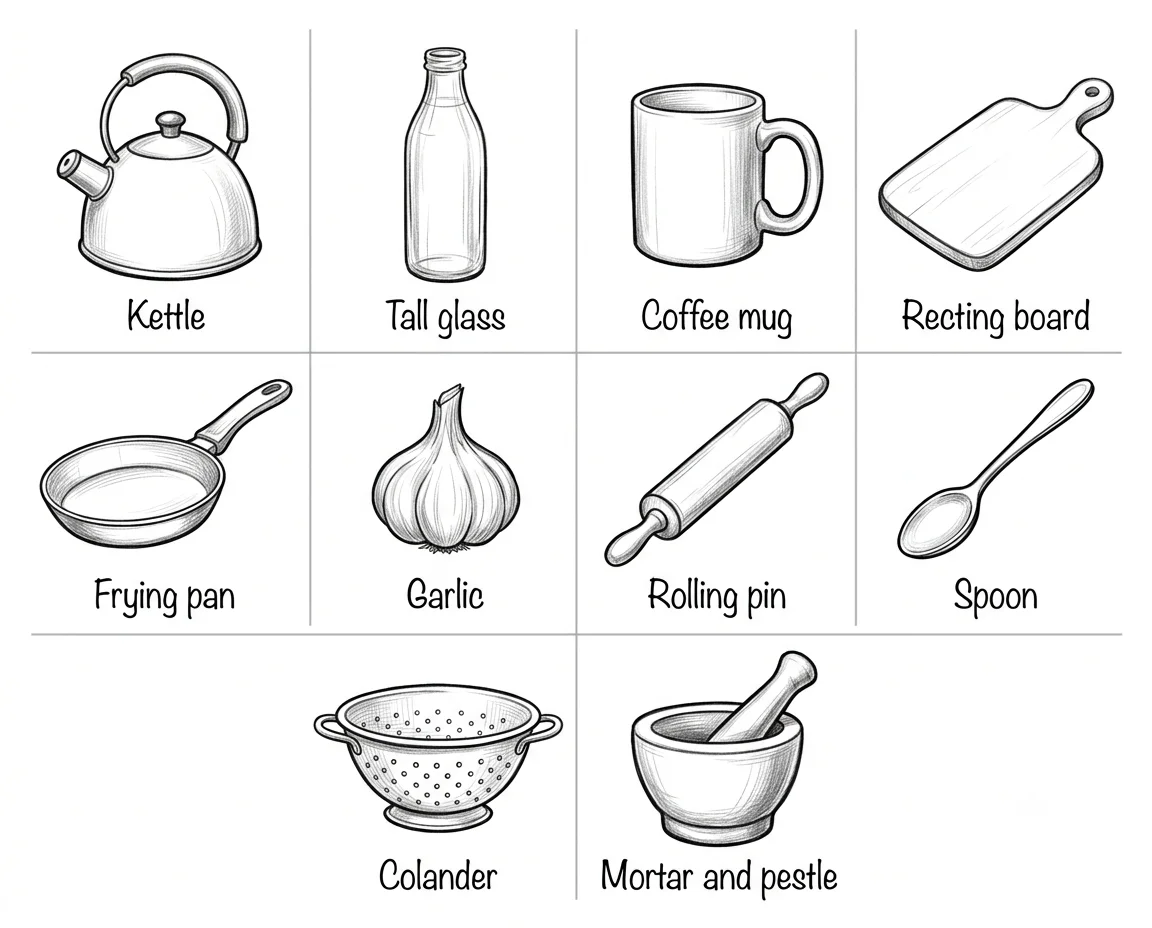
Kettle
A round body with a spout and handle. Good for combining curves and straight lines.
Glass Bottle
A tall narrow shape with a small opening at top. Great for practicing transparency and shading.
Coffee Mug
A cylinder with a thick handle. Simple shape with good shading practice on the surface.
Cutting Board
A flat rectangle with rounded corners. Good for straight lines and wood grain texture.
Frying Pan
A flat circle with a long handle. Great for practicing flat surfaces and simple shadows.
Garlic Bulb
A round bulb shape with papery layers on top. Good for organic shapes and soft shading.
Rolling Pin
A long cylinder with two small handles on each side. Great for clean straight lines.
Spoon
A thin handle with an oval bowl at one end. Good for practicing smooth curves.
Colander
A round bowl with many small holes. Great for patience and repeating detailed practice.
Mortar and Pestle
A heavy bowl with a thick grinding stick. Good for solid shapes and weight in drawing.
4. Animals and Creatures
Best for proportions and expression. Skill focus is curves and character.
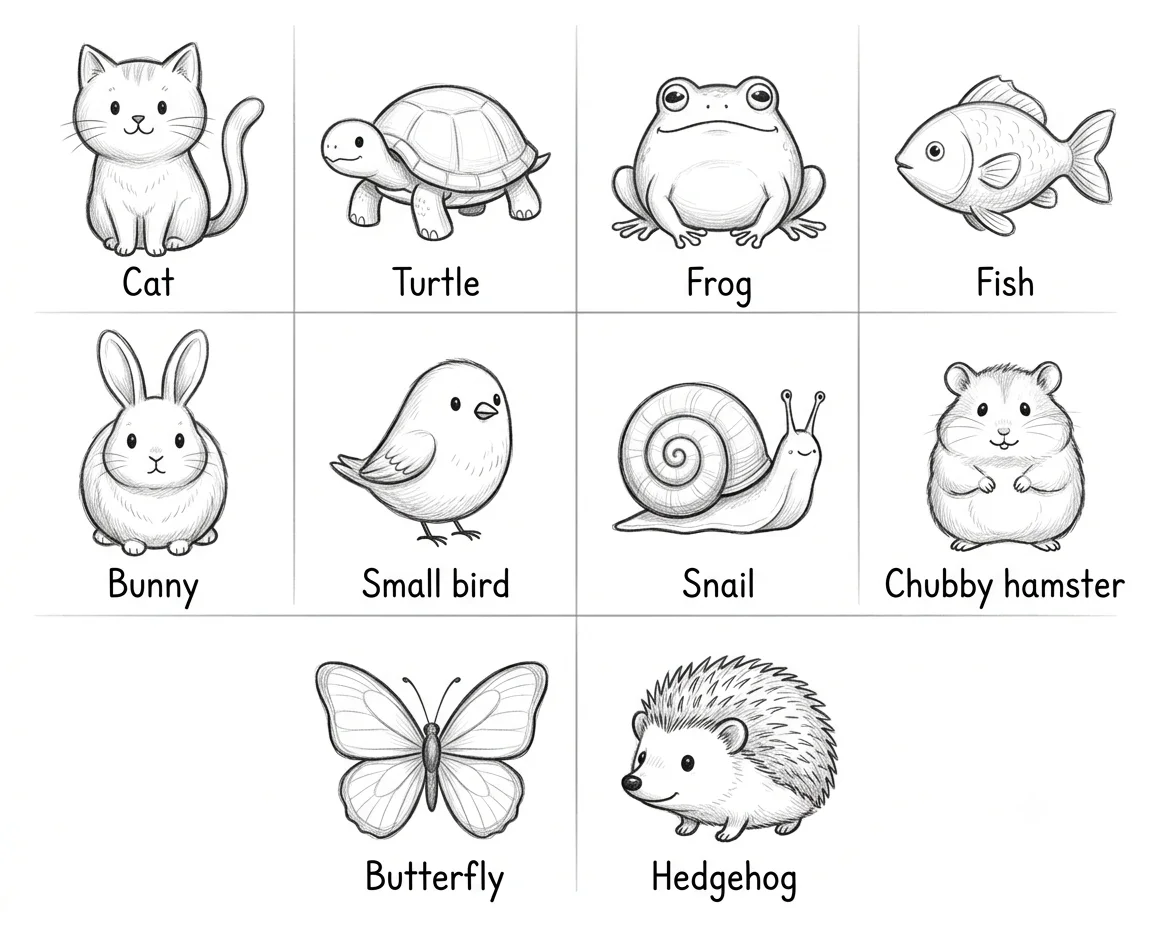
Cat
A round head with pointed ears and a long tail. Great for soft curves and simple expressions.
Turtle
An oval shell with four small legs and a head. Good for combining texture and basic shapes.
Frog
A wide round body with large eyes on top. Great for practicing proportion and character.
Fish
A simple oval body with fins and a tail. Good for smooth flowing lines and shading.
Bunny
A round body with two long ears. Great for soft curves and simple fur texture.
Bird
A small oval body with wings and a tiny beak. Good for light strokes and clean lines.
Snail
A small body with a spiral shell on top. Great for practicing spiral shapes and texture.
Hamster
A chubby round body with tiny ears and paws. Good for soft shapes and cute expressions.
Butterfly
Two pairs of wings with symmetrical patterns. Great for practicing symmetry and detail.
Hedgehog
A round body covered with short spines on the back. Good for repeating lines and texture.
5. Cool and Creative Objects
Best for structure and clean lines. Skill focus is straight lines and angles.
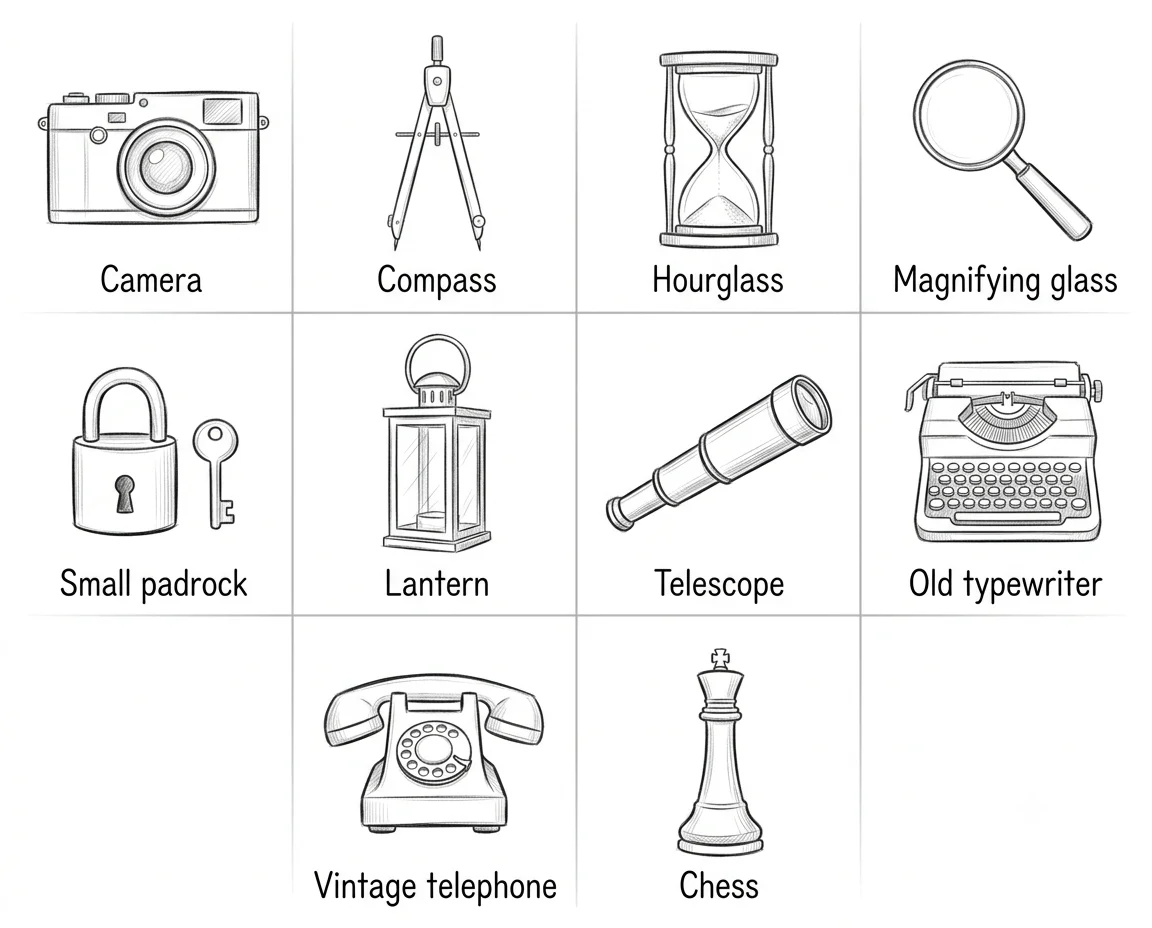
Camera
A rectangular body with a round lens in the center. Great for combining shapes and clean details.
Compass
Two thin legs joined at the top with a pointed end. Good for precise lines and symmetry.
Hourglass
Two triangles connected at the middle with sand inside. Great for symmetry and shading practice.
Magnifying Glass
A circle with a short handle attached. Good for clean curves and simple detail.
Lock and Key
A small padlock with a matching key beside it. Great for practicing detail and proportion.
Lantern
A rectangular glass frame with a handle on top. Good for structure and light effect practice.
Telescope
A long cylinder that gets wider at one end. Great for clean straight lines and perspective.
Typewriter
A boxy shape with rows of small round keys. Good for patience and repeating detail practice.
Vintage Phone
A rectangular base with a curved handset on top. Great for combining straight and curved lines.
Chess Piece
A tall narrow shape that widens at the base. Good for smooth curves and symmetrical form.
6. Random and Unexpected Objects
Best for observation and surprise. Skill focus is drawing outside your comfort zone.
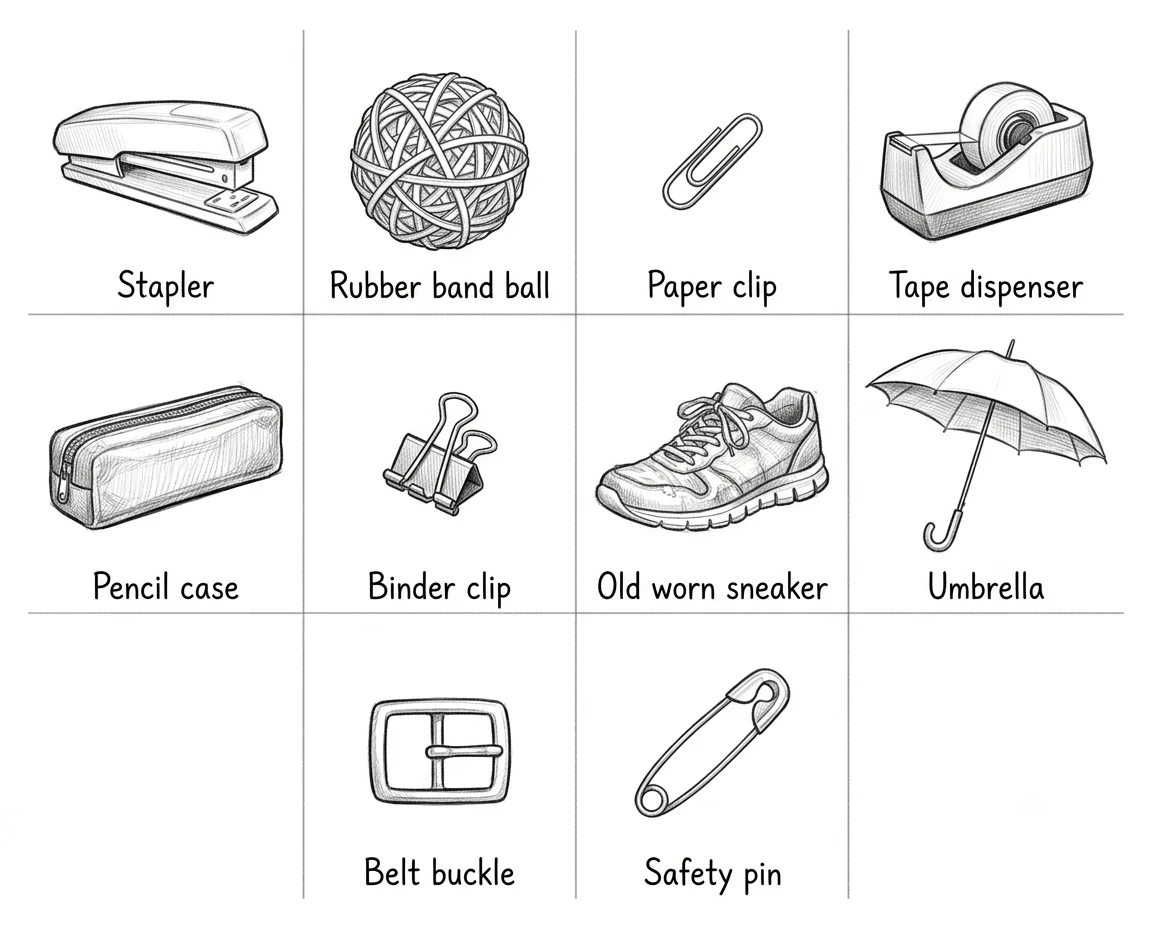
Stapler
A flat rectangular shape with a curved top. Good for clean lines and simple mechanical detail.
Rubber Band Ball
A round ball made of overlapping bands. Great for practicing layered texture and circular form.
Paper Clip
A small looped wire shape. Good for precise lines and understanding simple three dimensional form.
Tape Dispenser
A weighted base with a circular tape roll on top. Great for combining different shapes together.
Pencil Case
A long rectangular pouch with a zipper on top. Good for soft edges and fabric texture practice.
Binder Clip
A small metal clip with two folding handles. Great for angular lines and small detail practice.
Old Sneaker
A shoe with laces, sole, and fabric texture. Good for observation and complex shape practice.
Umbrella
A curved canopy with a long handle below. Great for smooth curves and repeating panel lines.
Belt Buckle
A small rectangular frame with a pin through the center. Good for precise detail and metal texture.
Safety Pin
A thin wire looped into a pin with a clasp at one end. Great for fine lines and small scale drawing.
If you specifically want drawing ideas for art practice, check our guide on random objects to draw for a structured approach to skill building.
Can not decide which object to draw? Use our free drawing idea tool and get an instant idea in one click.
7. Bonus 50 More Quick Ideas
No descriptions needed. Just pick one and start drawing.
The Smarter Way to Never Run Out of Ideas
Lists are helpful but they run out. You go through the same ideas, skip the ones that feel too hard, and end up staring at the page again. That is the real problem with drawing from a fixed list.
A better way is to let something else pick for you. Our free object generator tool does exactly that. You open it, click once, and get a random object instantly. No decisions, no scrolling, no wasted time. Just a subject and a blank page.
The tool gives you objects from multiple categories including household items, nature, food, tools, and more. You can also filter by category or difficulty if you want something specific. It works on mobile and desktop with no signup needed.
Next time boredom hits and the list feels too long, just open the tool and click once. Your next drawing subject is one second away.
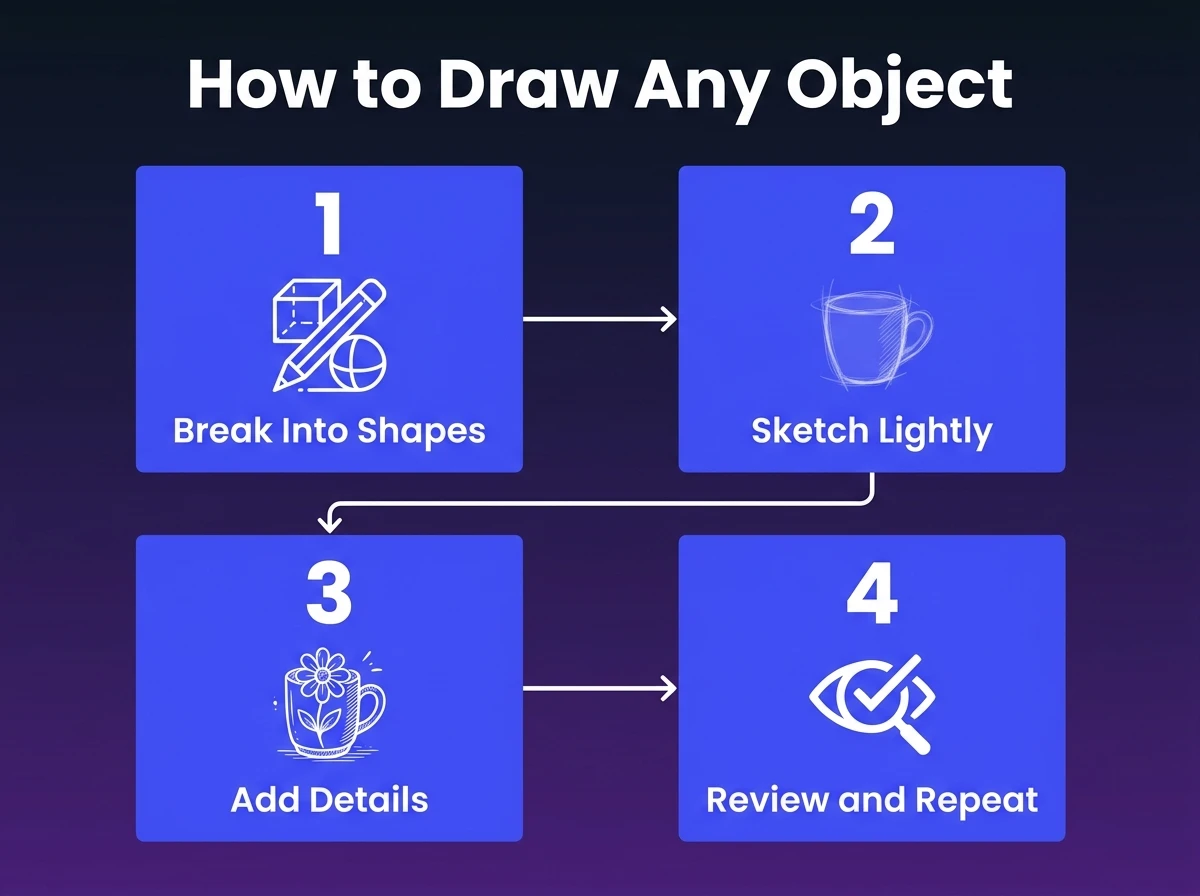
How to Draw Any Object in 4 Steps
Any object on this list can be drawn with the same simple method. Artists who practice with random objects consistently improve faster than those who always choose familiar subjects. It works for beginners and experienced artists both.
Step 1: Break it into basic shapes
Look at the object and find the simple shapes inside it. A mug is a cylinder. A book is a rectangle. A bird is two ovals. Starting with shapes makes any object feel less difficult.
Step 2: Sketch lightly first
Do not press hard on your pencil at the start. Light lines are easy to fix and erase. This is the foundation of contour drawing. Get the basic shape and proportions right before adding any detail.
Step 3: Add details slowly
Once the basic shape looks right, start adding details. The handle on a mug, the veins on a leaf, the laces on a shoe. This is how still life drawing works. Big shapes first, small details last.
Step 4: Review and repeat
When you finish, look at your drawing for one minute. What worked? What did not? Then pick a new object and go again. Repeating this process is what builds real skill over time.
Tips to Make Boredom Drawing More Fun
Small changes in how you practice make a big difference in how fast you improve.
Set a 10 Minute Timer
Give yourself a short time limit for each drawing. A timer stops you from overthinking and keeps the session moving. When the timer ends, the drawing is done whether it looks perfect or not.
Pick Randomly and Do Not Overthink
Do not spend time choosing what to draw. Close your eyes, point at the list, and draw whatever you land on. The less you think about the subject, the faster you start drawing.
Draw the Same Object 3 Ways
Pick one object and draw it three times. First time from the front, second time from the side, third time from above. This simple exercise teaches you more than drawing three different objects.
Keep One Sketchbook Only for This
Have a separate sketchbook just for boredom drawing sessions. After 30 days, flip back to page one. Seeing your own progress is one of the strongest motivators to keep going.
Share Your Drawing with Someone
Show your drawing to a friend, family member, or post it online. Sharing creates a small sense of accountability. It makes you want to draw again tomorrow.
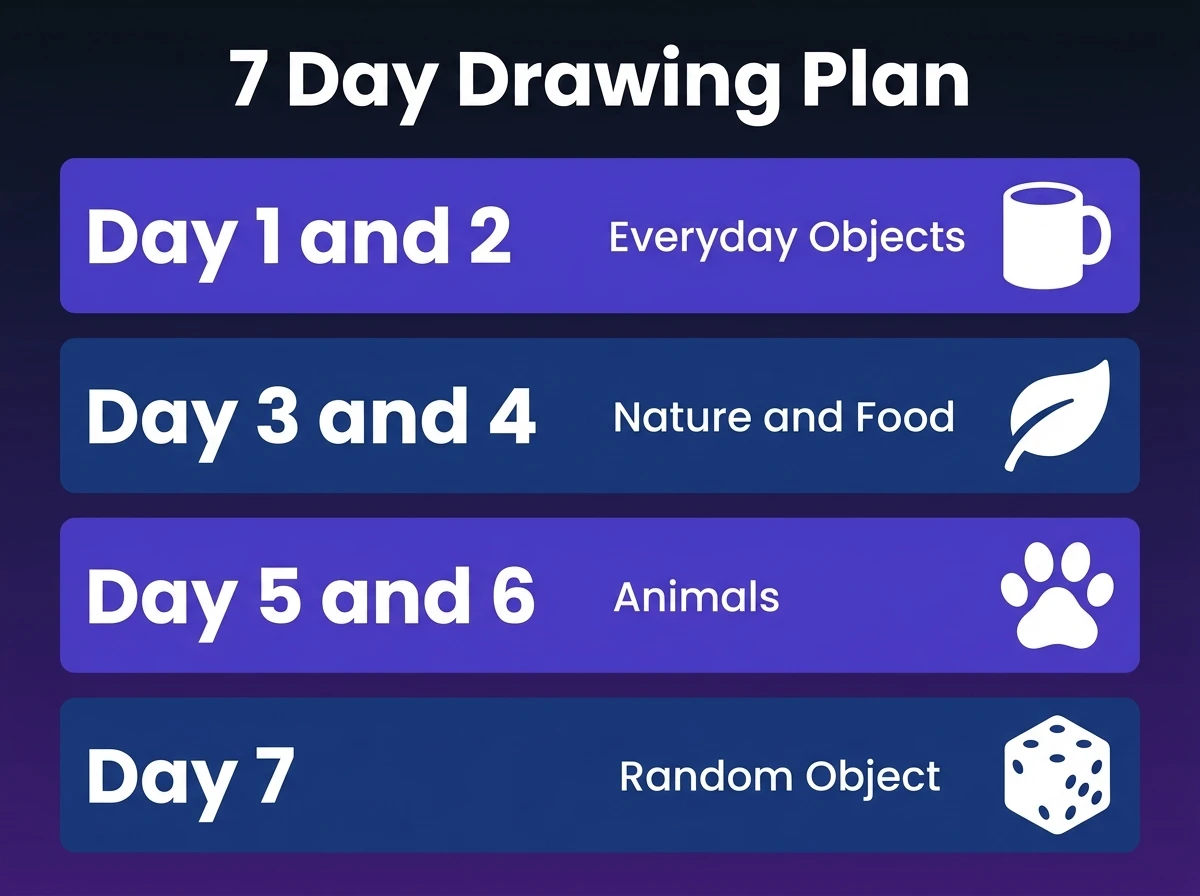
Try a 7 Day Boredom Drawing Plan
One object a day is all you need. This simple plan gives you a starting point for your first week.
Day 1 and 2: Easy Everyday Objects
Start with things around your home. A mug, a book, a candle or a lamp. These are simple shapes that build your basic observation skills without any pressure.
Day 3 and 4: Nature and Food Items
Move to organic shapes. A dry leaf, a pine cone, a garlic bulb or a glass bottle. These objects teach you how to draw irregular edges and soft textures.
Day 5 and 6: Animals and Creatures
Try a cat, a turtle, a frog or a butterfly. Animals teach you proportion and expression. Keep them simple and focus on getting the overall shape right.
Day 7: One Random Object
On the last day use our random object generator tool and draw whatever it gives you. No choosing, no planning. Just draw the object and finish the week strong.
After 7 days, pick a new category and keep going. One object a day is enough to see real improvement in your sketchbook.
Frequently Asked Questions
What are easy things to draw when bored?
Start with simple household objects. A mug, a candle, a book, or a clock are all great choices. Clear shapes, easy to find at home, no special skill needed.
What to draw when you have no ideas at all?
Look around the room and draw the first object you see. A pen, a shoe, a water bottle. The subject does not matter. Just start.
Can drawing when bored actually improve your skills?
Yes. No pressure means you draw freely and pick unusual subjects. That relaxed practice is where real improvement happens.
What should a complete beginner draw first?
Start with a mug or a book. Simple shapes, easy to find at home. Draw the outline first then add small details.
What are cool things to draw when bored?
A camera, an hourglass, a lantern, or a chess piece. Interesting shapes that make the drawing feel more satisfying when finished.
How long should I spend on each drawing session?
Ten to fifteen minutes per object is enough. Short focused sessions work better than long unfocused ones.
Can I use a random object generator for drawing ideas?
Yes. Our free object generator tool gives you an instant drawing subject in one click. No decisions, just draw.
Summary
Drawing random objects when bored is one of the fastest ways to improve your observation and sketching skills.
This list gives you 100+ ideas across 6 categories. Start with easy everyday objects, move to nature and food, then work up to animals and cool creative objects.
Use the 4 step method for any object. Break it into shapes, sketch lightly, add details slowly, then review and repeat.
One object a day for 7 days is enough to see real progress in your sketchbook.
And when the list feels too long or you simply cannot decide, use our free object generator tool for an instant idea in one click.