Pictionary is a drawing game. One player sketches a secret word, and teammates try to guess it before time runs out. You can play with the official board game, or with nothing more than paper, a pen and a list of words.
Quick answer: Split into two teams. One player, called the Picturist, sees a secret word and draws it. No talking, no letters and no numbers allowed. Teammates shout out guesses for one minute. A correct guess scores. The first team to reach the last square on the board, or the score you agreed on, wins.
This guide explains the official rules in plain words, then shows how to score, how long the timer should be, and how to play without the board, with two or three players, with kids and over a video call. It also gives you five easy steps for using our free Pictionary word generator, so nobody has to write cards.
A little history helps explain why the rules are so short. Robert Angel, working with graphic designer Gary Everson, came up with the idea in 1981, and the game was first published in 1985, according to Wikipedia. The rules below follow the official Mattel instruction sheet for the board game.
What You Need to Play Pictionary
You need at least four people, split into two teams. The Mattel board game is made for two teams and for ages 8 and up. Here is what each version needs.
| Item | Official board game | Home version |
|---|---|---|
| Words | Word cards (120 adult and 80 junior cards) | A list of words, paper cards or a word generator |
| Drawing space | 2 erasable boards and 2 markers | Paper, a whiteboard or a screen |
| Timer | Sand timer, one minute | A phone timer or an on screen timer |
| Tracking progress | Game board and 2 movers | A score sheet or a whiteboard tally |
| Other | A die and 4 category cards | Nothing else |
No word cards? Use our list of Pictionary words by difficulty or let the free word generator pick for you.
Pictionary Rules in 6 Steps
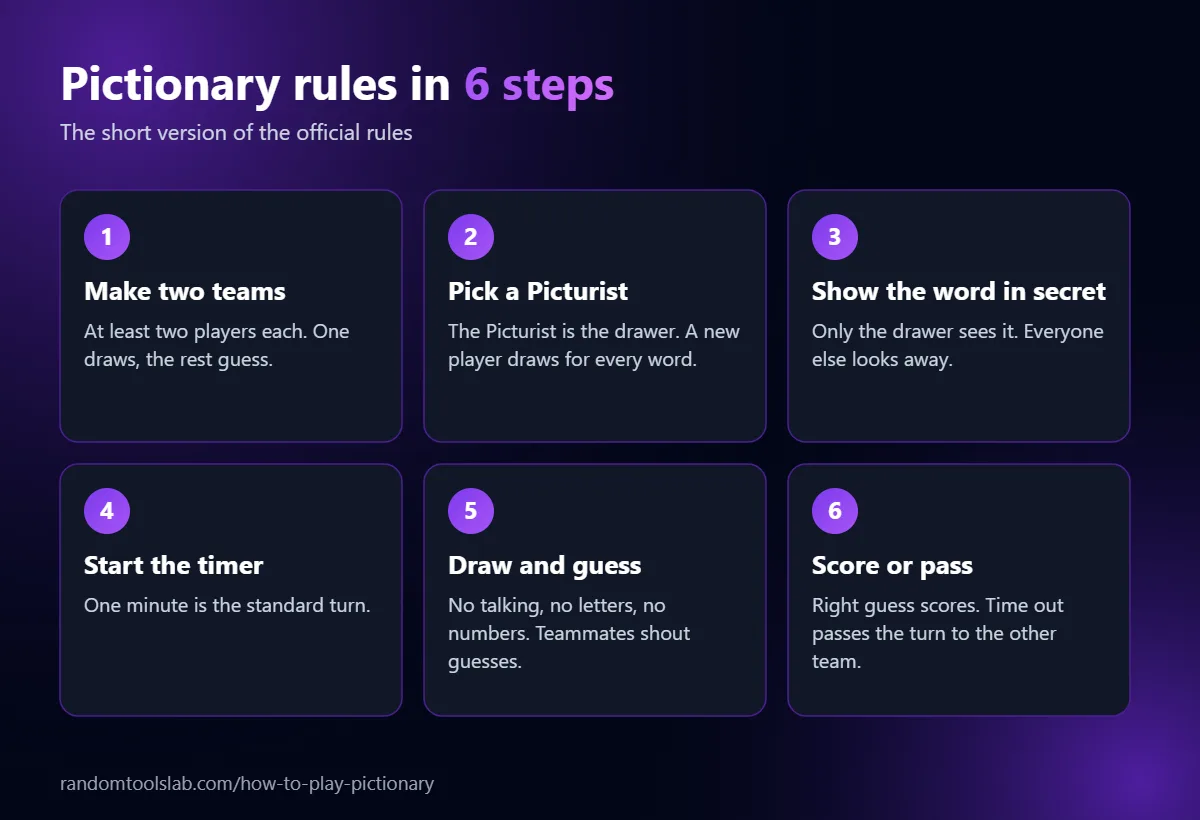
These six steps cover almost every game.
- Make two teams. Each team needs at least two players, one to draw and one or more to guess. Try to keep the teams close in size.
- Pick the first Picturist. This is the player who draws. A new player draws for every new word.
- Show the secret word to the Picturist only. The rest of the room must not see it.
- Start the timer. The standard turn is one minute.
- Draw, and guess out loud. The Picturist sketches clues. Teammates call out guesses. The Picturist cannot speak, write letters or numbers, or use gestures that act out the word.
- Score or pass the turn. If the team guesses the word in time, it scores or moves ahead on the board. If time runs out, the other team gets its turn.
That is the whole game. Everything below is detail for special cases.
How One Round Works
Here is a sample round so you can see how the rules fit together. Team Red and Team Blue are playing, and it is Red’s turn.
- Maya is Red’s Picturist. She looks at the card in secret. The word is “umbrella.”
- Someone starts the one minute timer.
- Maya draws a curved line with a handle, then rain drops. She says nothing.
- Her teammates shout: “Hat? Rain? Raincoat? Umbrella!” That is correct, and the timer stops.
- Red scores. On the official board, Red rolls the die and moves its piece that many squares.
- A different Red player becomes the Picturist for the next word. Red keeps going as long as it keeps guessing right.
- If Red runs out of time, Blue gets the turn.
The key idea is simple. The Picturist changes for every word, and a team keeps its turn only while it keeps guessing.
What You Can and Cannot Do When Drawing
The drawer has more freedom than most people think. The limits are about words, not pictures.
| You can | You cannot |
|---|---|
| Draw anything linked to the word, even loosely | Write letters or numbers |
| Break a word into parts, such as drawing a dock for “doc” | Talk or make any sounds with your voice |
| Use arrows or simple symbols, if your group agrees first | Use “sounds like” gestures or sign language |
| Keep adding to your sketch as guesses come in | Draw dashes to show how many letters the word has |
These limits come from the official Mattel rules. The same sheet says teams should agree before the game on how exact a guess must be. For example, decide whether “car” is enough when the word is “sports car.”
Two extra rules help many home groups. First, no pointing at things in the room. Second, if a team gets stuck, the Picturist can start over with a new sketch. Agree on both before you start so nobody argues later.
How Long Is the Pictionary Timer?
The standard Pictionary timer is one minute. The official board game comes with a sand timer that runs for 60 seconds, and a team gets one timer per word.
You can change that to fit your group. These are common choices:
| Timer | Best for |
|---|---|
| 30 seconds | Fast rounds, easy words, experienced players |
| 60 seconds | The standard game and mixed groups |
| 90 seconds | Younger players, or hard words |
| 120 seconds | Very hard words, or players who are still learning to sketch |
One tip: pick one timer length and keep it for the whole game. Changing it from turn to turn makes scores hard to compare. Our free word generator has 30, 60, 90 and 120 second presets, plus a “no timer” option for relaxed play.
Scoring and How to Win
How you win depends on whether you use the board.
With the board: There are no points. Each correct guess earns a die roll, and the team moves that many squares. A team wins when it reaches the last square, which is an All Play square, and then wins the next All Play round by guessing the word first. It must also hold the die at that moment. It does not need an exact roll to get there.
Without the board: Use points. This is the simple system most home groups use:
- A correct guess is worth 1 point.
- Before you start, agree on a target score. Five, seven and ten are the usual choices. Five points is a good fit for a short game night.
- The first team to reach the target wins.
- If you run out of time instead, the team with the most points after an equal number of turns wins.
- If the score is tied, play one more word. The first team to guess it wins.
Optional rule: when you mix easy and hard words, give 2 points for a hard word. This keeps the game fair when one team gets unlucky words.
Pick one person to keep score, or write the tally on a whiteboard where everyone can see it. In our word generator, the Got it button adds one point to the team whose turn it is, and the score boxes keep the count for you.
Playing With the Official Board Game
The board game adds a path, a die and colored squares to the basic rules. This section follows the Mattel instruction sheet. Editions can differ a little, so check the sheet in your box if something does not match.
Set up
- Take the four category cards out of the adult deck and set them aside as a reference.
- Put the card boxes and the sand timer where everyone can reach them.
- Make two teams. Each team gets an erasable board, a marker, a category card and a mover. Both movers start on the Start square.
- Each team picks its first Picturist.
- Both teams roll the die. The higher roll goes first.
What the colored squares mean
Every adult card has five clues, one for each color. The color of the square your mover stands on tells you which clue to draw.
| Color | What you draw |
|---|---|
| Yellow | Objects, things you can touch or see |
| Blue | People, places or animals, including names |
| Orange | Actions |
| Green | Difficult words |
| Red | Pop culture, such as movies, TV and celebrities |
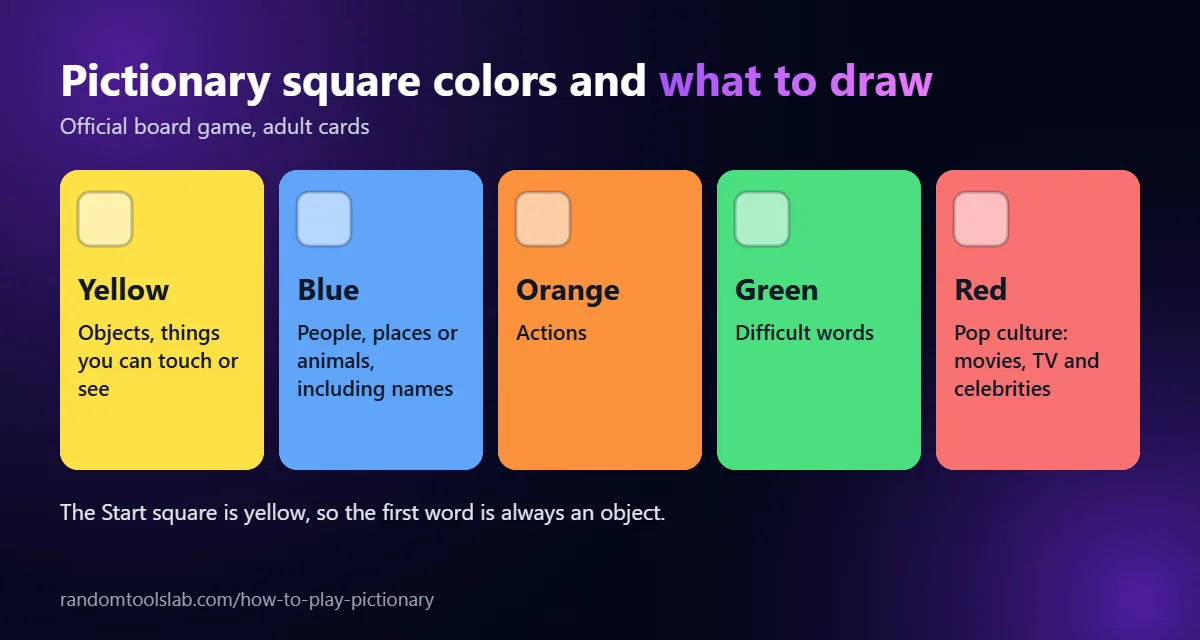
The Start square is yellow, so the first word is always an object. The first team does not roll the die for that first word.
Taking a turn
- The Picturist takes the top card and looks at the word in secret.
- The sand timer starts. The Picturist sketches and the team guesses until it gets the word or time runs out.
- After a correct guess, the team rolls the die, moves that many squares and picks a new Picturist.
- The team keeps the die for as long as it keeps guessing right.
- If time runs out, the team loses the die. The other team draws a new card for the square it is standing on, without rolling, and starts a new minute.
All Play and Wild squares
When a team lands on an All Play square, both teams guess the same word at the same time and both Picturists sketch. The first team to guess it rolls the die and keeps going. If nobody guesses in time, the other team gets the turn.
On a Wild square, the Picturist can pick any category. With adult cards, the Picturist must say the category out loud before drawing.
Winning the board game
Reach the last All Play square, hold the die, and be the first to guess the word in the next All Play round. Your roll does not have to be exact to get there.
How to Play Pictionary Without the Board
You do not need the board game at all. Most people play at home with paper and a pen, and the game works just as well. The only thing you swap out is the board, so you track progress with points instead.
- Gather your tools. You need paper and pens, or a whiteboard and markers. A phone timer works for the one minute clock.
- Get your words. Write words on slips of paper and drop them in a bowl, or use an online Pictionary word picker that shows one word at a time. If you want to prepare cards, our Pictionary words list has more than 200 ideas sorted by difficulty.
- Make two teams and decide who draws first.
- Agree on the rules out loud. Settle the timer length, the target score and how exact a guess must be.
- Play turns. The drawer looks at the word, the timer starts, and the team guesses. A correct guess is one point.
- Rotate the drawer every word so everyone gets a turn, and switch teams after each turn.
- Stop at the target score, or after an agreed number of rounds.
A large whiteboard or a big sheet of paper on a wall helps the whole room see the sketch. If the group is bigger than eight people, make three or four teams and rotate. This also keeps waiting time short.
How to Play Pictionary With Two or Three Players
The official game needs two teams, so two or three people have to adjust. These are house rules, not official ones, but they work well.
Two players, take turns: One person draws, the other guesses. Swap after every word. A correct guess scores 1 point for the guesser. First to 7 points wins.
Two players, team up: You are one team, and the clock is your opponent. Set a timer for 5 minutes, then see how many words you can get right together. Try to beat your own record next time.
Three players: One person draws and the other two guess. The first guesser to say the right word gets 1 point, and the drawer also gets 1 point. Rotate the drawer after every word. Everyone draws the same number of times, so the scores stay fair.
In all three versions, one person needs to hold the word list or the phone, so keep the card face down until the drawer is ready.
How to Play Pictionary With Kids and Mixed Ages
Pictionary works for children, but the standard rules can feel hard for younger players. A few small changes fix that.
- Use the junior version. Mattel makes a Pictionary Junior game with easier words for children ages 7 to 12. The adult game is rated for ages 8 and up.
- Pick easy words. Stick with things a child sees every day, like a cat, a cup or a house. Our list of easy Pictionary words sorts ideas by easy, medium and hard, so you can choose the right level.
- Pair a child with an adult. Put one younger player and one older player on each team. The older player can guess more slowly and give the child time to draw.
- Give younger players more time. Use the 90 or 120 second timer instead of 60 seconds.
- Let them draw simple shapes. A circle and two triangles can be a cat. Cheer for the effort, not the art.
- Skip the hard words. If a card is too tricky, pick another one. Nobody needs to win every round.
In a classroom, you can split students into small teams and rotate the drawer so everyone gets a turn.
How to Play Pictionary on a Video Call
You can play Pictionary with friends or a class on Zoom, Google Meet or any other video app. You only need a shared drawing space and a word source.
- Open a shared drawing space. In Zoom, the host can use Zoom Whiteboard in a meeting. Other apps have a whiteboard or screen share option too. A shared slide or online drawing page also works.
- Make teams. Use breakout rooms for teams, or keep everyone in one room and take turns by team.
- Get the word privately. The drawer needs to see the word without the others seeing it. Open a word generator on a separate device, or on a window the drawer does not share. A host can also message the word to the drawer in a private chat.
- Draw and guess. The drawer draws on the shared board while the others type or say their guesses. Keep the same rules: no letters, no numbers and no talking from the drawer.
- Use a timer. Pick a time limit, such as 60 seconds, and let the host call time.
If the drawer is not good with a mouse, a finger on a phone or tablet screen is usually easier.
How to Use Our Pictionary Word Generator, Step by Step
Our free Pictionary game tool with timer and scoreboard replaces the card deck. It works on a phone, tablet or computer, and you do not need to sign up.
- Open the tool and choose a level. Tap All, Easy, Medium or Hard. Pick Easy for kids and Hard for a challenge. You can also pick a topic, such as Animals or Food, from the topic menu.
- Set the timer. Choose 30, 60, 90 or 120 seconds from the timer menu, or pick No timer. Turn the sound on or off with the speaker button.
- Set up your teams. Tap the plus button to add a team, or the minus button to remove one. Tap a team box to make it the active team.
- Tap New word. The card stays face down, so only the drawer should look. When the drawer is ready, tap the card to show the word.
- Draw, guess and score. The drawer starts drawing while the timer runs. If the team guesses right, tap Got it. That adds 1 point to the active team and passes the turn to the next team. If the drawer wants a different word, tap Skip. Skip gives a new word and keeps the same team.
Here is the whole screen with every control numbered, so you can find each one fast.
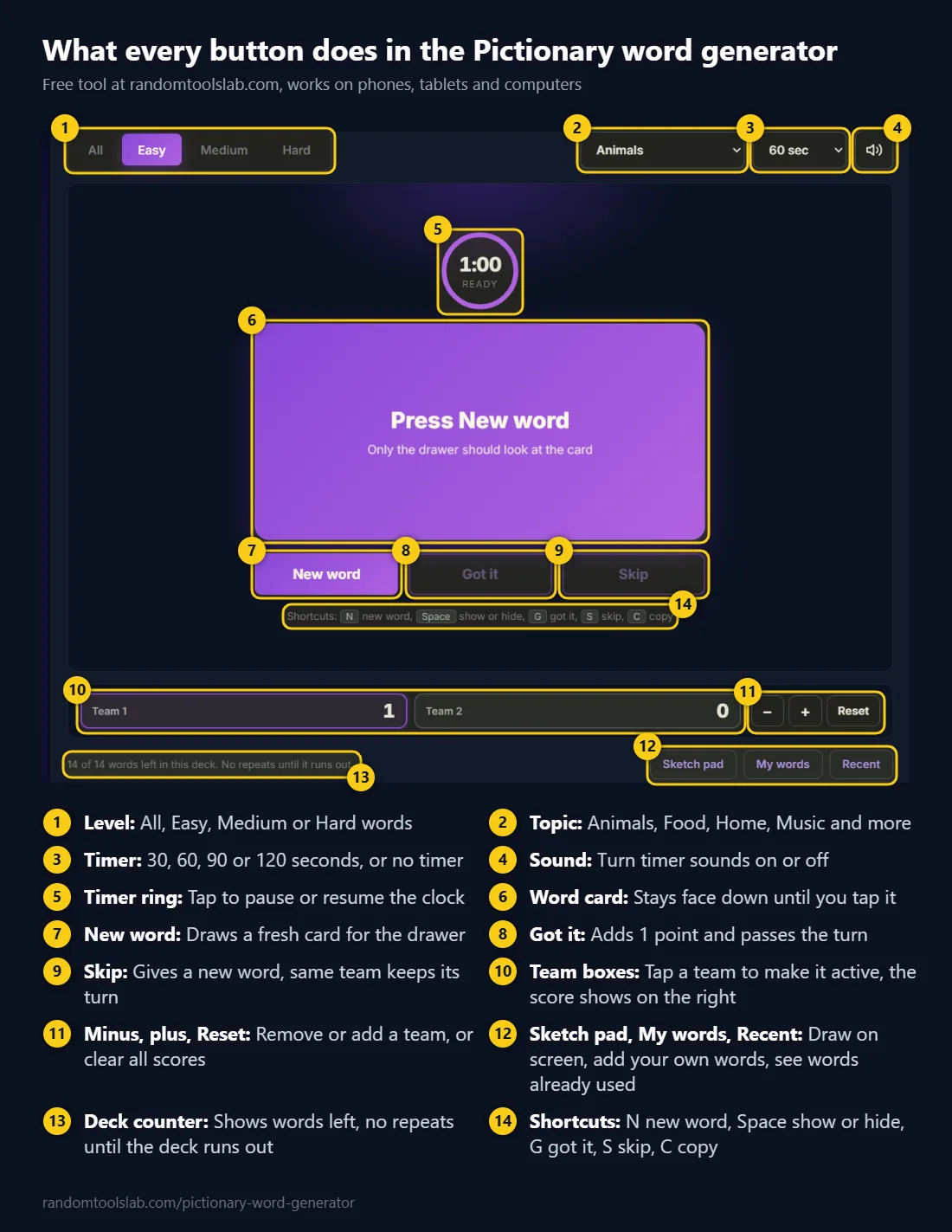
Extra buttons: Use Reset to clear the scores, Sketch pad to draw right on the screen, My words to add your own words, and Recent to see the words you already used.
Keyboard shortcuts on a computer: N for a new word, Space to reveal the card, G for Got it, S for Skip and C for the sketch pad.
Pictionary Tips for Drawing and Guessing
Tips for the drawer
- Start with the biggest, simplest shape. Add details only if your team needs them.
- Draw the thing, not the word. If the word is “sunburn,” draw a sun and a red person.
- Break long words into parts. Draw each part, one at a time.
- Do not erase unless you have to. Time moves fast, and a messy drawing can still help.
- Point at things you already drew to say “yes, this part matters.” That is allowed.
Tips for the guessers
- Say your guesses out loud, even if they are silly. A wrong guess can help the drawer fix the picture.
- Start with the category. Is it a thing, a person, an action or a place?
- Build on the last guess. If someone says “boat,” try “ship,” “sail” or “ocean.”
- Stay quiet for a moment if the drawer looks like they have a plan.
Tips for the team
- Pick drawers by turns, not by who is best at art. Stick figures win games.
- Agree before the game on how exact a guess must be, as the official rules suggest.
Want more things to practice on? Try our random objects to draw list for quick sketching ideas.
Pictionary Rules FAQ
How many people do you need to play Pictionary?
The official game is built for two teams, with at least two players on each team. You can play with two or three people using the house rules above.
Can the drawer talk or use gestures?
No. The drawer cannot speak, make sounds or use sign language. The drawer also cannot act out the word. Pointing at parts of the drawing is fine.
Can you use letters and numbers in a drawing?
No. Letters and numbers are banned, and so are dashes that show how many letters are in the word.
What happens when time runs out?
In the board game, the other team gets the die and draws for its own square. In a simple game without the board, no one scores and the next team goes.
What does All Play mean?
On an All Play square, both teams draw and guess at the same time. The first team to guess the word wins the round.
What is the age rating for Pictionary?
The standard Mattel game lists ages 8 and up. Pictionary Junior is made for younger children.
Who invented Pictionary?
According to Wikipedia, Robert Angel created the game with graphic designer Gary Everson. The idea came in 1981 and the game was first published in 1985.
Sources and Related Guides
Sources we used
- Official Pictionary instructions from Mattel (PDF)
- Pictionary Junior instructions from Mattel (PDF)
- Pictionary on Wikipedia
- Using Zoom Whiteboard in a Zoom meeting
Keep playing
- Random object generator: more random things to draw, write about or play with.